

Why Independent Artists Avoid Social Media in 2026
- Sasha Bursak
- Jun 7
- 8 min read
Social media avoidance among independent artists is a deliberate, research-backed response to platforms that systematically undermine reach, mental health, and creative control. The term “platform withdrawal” is increasingly used by music industry analysts to describe this pattern, though most artists simply call it survival. Why independent artists avoid social media comes down to three compounding problems: algorithms that bury content from the very followers you earned, psychological costs that erode the will to create, and platform policies that can erase years of audience-building overnight. This article breaks down each of those forces and maps out the alternatives that are actually working in 2026.
Why independent artists avoid social media: the algorithm problem
Organic reach for independent artists on platforms like Facebook and Instagram is often below 5%, meaning fewer than five of every hundred followers see a given post. That number is not a glitch. It is the intended design of an advertising-driven business model. Platforms profit when artists pay to boost content, so the algorithm withholds free reach by default.
“You are not building an audience on social media. You are renting access to one, and the landlord sets the rent.”
The practical consequence is what Hypebot calls the “locked room” effect. An artist with 10,000 Instagram followers may reach 400 to 500 people per post organically. That figure makes social media a deeply inefficient channel for independent musicians avoiding online platforms as their primary promotional tool. The perceived audience size and the actual reach are two completely different numbers, and conflating them leads to wasted effort.
Algorithms also decide which followers see content based on engagement signals, not chronology or loyalty. A fan who bought your last album but rarely double-taps posts will stop seeing your updates entirely. This creates a feedback loop where artists chase engagement metrics rather than building genuine relationships. Social media algorithms reward outrage and frenzy over thoughtful, authentic creative work, pushing artists toward content that performs in the feed but dilutes their artistic identity.
What does social media do to an artist’s mental health?
The psychological toll of maintaining a social media presence is one of the most underreported disadvantages of social media for artists. A 2026 study published in Scientific Reports directly links platform features with social media burnout mechanisms, identifying algorithm-driven social comparison as a primary driver of fatigue and withdrawal behaviors.
A separate 2026 study introduced the concept of “audience entanglement,” which describes creators becoming emotionally dependent on audience metrics. Successful creators in that study reported feeling trapped in a “chamber of despair,” where every post became a referendum on their worth. Large audiences, paradoxically, increase psychological burden rather than reduce it.
The specific pressures that drive burnout among independent artists include:
Constant content production. Independent artists spend hours daily creating social content, time that comes directly out of making actual art.
Always-on performance. Burnout extends beyond posting to include the pressure to respond, react, and stay visible at all hours.
Creative distortion. The constant visibility feedback loop pushes artists toward feed-friendly output rather than work they actually believe in.
Social comparison. Watching peers accumulate followers and streams triggers anxiety that has nothing to do with the quality of your own work.
Social media also creates what researchers describe as a double bind for artists: stepping back feels like career suicide, but staying in depletes the creative energy that makes the work worth promoting in the first place. That trap is a core reason why artists dislike social media even when they understand its promotional logic.
Pro Tip: Set a hard boundary between content creation time and music creation time. Treat them as separate jobs with separate schedules. Mixing them is how one bleeds into the other until both suffer.
What are the real risks of platform control and account suspension?
Platform control is the third major reason behind indie artists and social media withdrawal, and it is the most concrete. A suspended account is not an inconvenience. It is the loss of every connection you built, with no guaranteed path to recovery.
Meta has suspended artist accounts without clear explanations, flagging legitimate small business profiles as fraudulent and routing appeals through automated systems that provide no meaningful recourse. The BBC documented multiple cases where creators lost access for weeks or months with no human review available. The financial and relational damage in those cases was immediate and severe.
The structural risks of platform dependency break down into four specific vulnerabilities:
No data portability. You cannot export your follower list or directly contact your audience. The platform owns that relationship, not you.
Opaque suspension triggers. Content moderation systems flag accounts based on criteria that are rarely published and frequently inconsistent.
No guaranteed appeals process. Automated review systems can deny appeals without explanation, leaving artists with no path to restoration.
Algorithm volatility. A single platform update can cut your organic reach in half overnight, with no warning and no compensation.
Exporting and directly messaging your audience is structurally impossible on social platforms. That single fact explains why so many experienced independent artists treat social media as a top-of-funnel tool at best, never as the foundation of their audience relationship.
How can artists build visibility without relying on social media?
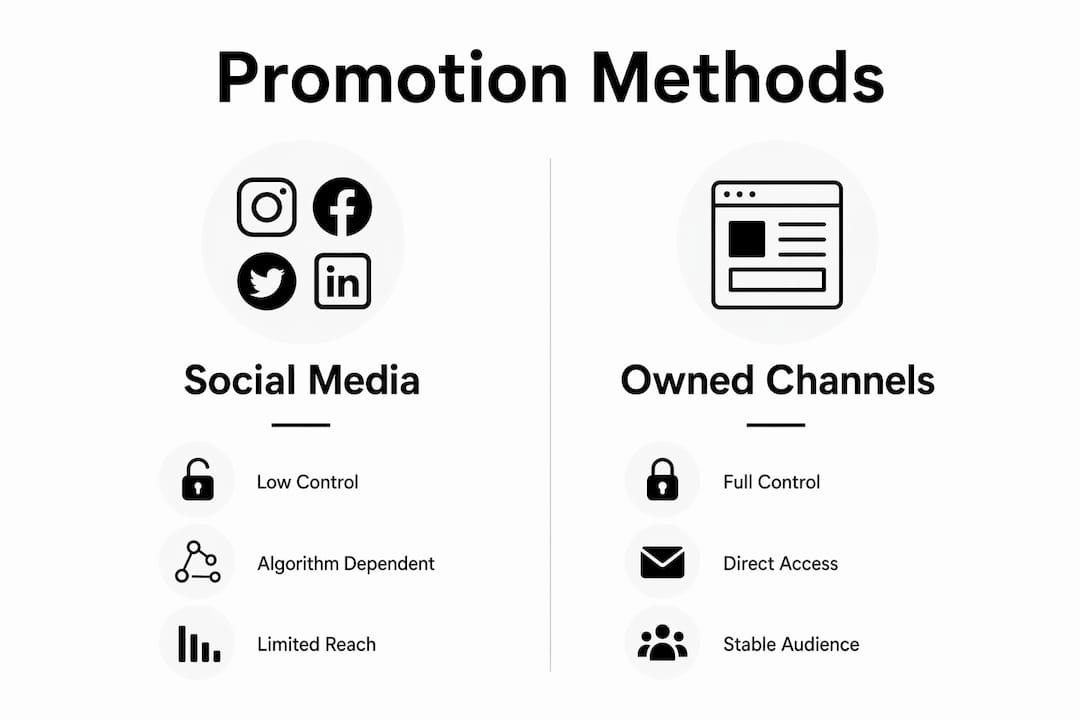
The most effective alternative marketing for indie artists centers on owned channels: assets you control, that no algorithm can suppress and no platform can suspend. The strategic shift is from renting an audience to owning one.
Email lists as the artist’s most reliable tool
An email list delivers your message directly to every subscriber, with no algorithmic filter between you and your fan. Platforms like Mailchimp, ConvertKit, and Substack give independent musicians a direct communication channel that survives platform shutdowns, algorithm changes, and account suspensions. Open rates for email consistently outperform organic social reach by a significant margin, making it the highest-return channel for digital presence for independent musicians.
Artist websites as stable home bases
A personal website functions as the one address on the internet that you fully control. It hosts your catalog, your story, your tour dates, and your mailing list signup. Unlike a social profile, it does not compete with other content for attention. Platforms like Bandzcamp, Squarespace, and WordPress give artists full ownership of their presentation without surrendering data or reach to a third party.
Using social media only for discovery
The most sustainable approach treats social media as a discovery channel, not a community channel. Routing social engagement to owned platforms separates top-of-funnel visibility from controlled, direct audience interaction. A post on Instagram or TikTok introduces you to a new listener. Your email list, website, or Patreon is where that relationship actually lives.
Channel | Control level | Reach reliability | Best use |
Social media (Instagram, TikTok) | Low | Unpredictable | Discovery and new audience exposure |
Email newsletter | Full | Guaranteed | Direct fan communication and releases |
Artist website | Full | Consistent | Catalog, press, and mailing list hub |
Patreon or membership platform | High | Stable | Monetization and superfan community |
If you want to explore Instagram alternatives that give independent entertainers more control over their audience relationships, several platforms have emerged in 2026 that prioritize creator ownership over algorithmic engagement.
Pro Tip: Every social post should include one clear path off the platform. A link to your email signup, your website, or your Patreon turns a fleeting impression into a durable connection.
A culture shift toward direct human connection and away from algorithmic gatekeeping is not idealism. It is the practical foundation of a sustainable independent music career.
Key takeaways
Independent artists avoid social media because algorithms suppress organic reach below 5%, platforms can suspend accounts without recourse, and the psychological cost of constant visibility actively damages creative output.
Point | Details |
Organic reach is structurally limited | Fewer than 5% of followers see posts organically on major platforms by design. |
Audience entanglement causes real harm | Emotional dependence on metrics leads to burnout and creative distortion, per 2026 research. |
Platform suspension risk is real | Account loss without appeal is a documented threat that can erase years of audience-building. |
Owned channels outperform rented ones | Email lists and artist websites deliver guaranteed reach that no algorithm can suppress. |
Social media works best as discovery only | Funnel new followers to owned assets to protect audience relationships from platform volatility. |
The uncomfortable truth about social media and creative careers
I have watched talented artists spend two years building Instagram followings of 20,000 people, only to find that their email list of 800 subscribers generated more ticket sales for a local show. That gap is not an anomaly. It reflects the fundamental difference between an audience you rent and one you own.
The pressure to stay visible on social media is real, and I am not dismissing it. Discovery still happens on these platforms. But the artists I have seen sustain careers over five or ten years share one habit: they treat every social interaction as a recruitment opportunity for their owned channels. They are not building a social media presence. They are using social media to build something that social media cannot take away.
The artists who manage audience entanglement best use cognitive reframing and internal creative standards rather than external metrics to measure their progress. That is not a soft skill. It is a professional discipline. Studiom8 was built with exactly this dynamic in mind, connecting creators to resources and communities that exist outside the algorithmic competition of traditional social platforms.
The future of independent artist promotion is not less visibility. It is visibility on your own terms, through channels you control, with fans who chose to hear from you directly.
— Christopher
How Studiom8 supports artists building beyond social media
Studiom8 is built for independent creators who want to grow their careers without competing in an algorithmic attention economy. The platform connects artists, musicians, producers, and engineers with recording studios, rehearsal spaces, and collaborators, while providing tools to distribute content, build a fanbase, and monetize work directly. For artists who have recognized the limits of social media and are ready to invest in owned audience assets, Studiom8 subscriptions offer a practical infrastructure for sustainable creative careers. You get access to a network of creative professionals and resources designed to support your work, not redirect your attention to someone else’s feed. Explore what Studiom8 offers independent artists ready to build on solid ground.
FAQ
Why do independent artists avoid social media?
Independent artists avoid social media primarily because organic reach is below 5% on major platforms, the psychological cost of constant visibility causes burnout, and account suspensions can erase audience relationships without warning or recourse.
What are the main disadvantages of social media for artists?
The core disadvantages are algorithmic suppression of reach, emotional burnout from audience entanglement, creative distortion toward feed-friendly content, and the inability to export or directly contact followers if an account is suspended.
How can independent musicians promote without social media?
Email newsletters, personal artist websites, and platforms like Patreon give musicians direct, algorithm-free access to their audience. The most effective strategy uses social media only for discovery and routes fans to owned channels for ongoing communication.
What is audience entanglement and why does it matter?
Audience entanglement is a 2026 research term describing creators who become emotionally dependent on audience metrics and reactions. It causes measurable psychological distress and burnout, making it a documented occupational hazard for independent artists with large social followings.
Is avoiding social media bad for an artist’s career?
Not necessarily. Artists who build strong email lists and owned platforms often generate more reliable engagement and revenue than those with large but algorithmically suppressed social followings. The risk is real, but so is the upside of owning your audience outright.
Recommended
Comments