

How Creative Professionals Find Collaborators in 2026
- Sasha Bursak

- Jun 5
- 9 min read

Creative professionals find collaborators most effectively by leading with specific-value fit: a concise pitch that names the complementary expertise, defines the deliverable, and states the next step. Generic outreach fails because it forces the recipient to do the mental work of imagining a partnership. The methods that actually close deals combine targeted human networking with AI-powered matching platforms, structured digital ecosystems like Studiom8, and psychosocial awareness that shapes how you tailor every ask. This article breaks down each layer so you can build a repeatable system for finding the right creative partners.
How creative professionals find collaborators: the specific-value fit method
Specific-value fit is the principle that every collaboration proposal must answer three questions immediately: why are we a match, what exactly will we make together, and what happens after you say yes. Proposals that answer these three questions get faster acceptance because they reduce the cognitive load on the recipient. When someone reads your pitch and can picture the finished project in thirty seconds, the barrier to saying yes drops sharply.
The difference between a winning pitch and a forgettable one comes down to specificity. Compare “I’d love to work together sometime” with “I produce lo-fi hip-hop instrumentals for a 40K Spotify audience. I think a 3-track EP with your vocal style would perform well on both our channels. I can have a rough demo ready by Friday if you’re open to a quick listen.” The second message does all the thinking for the recipient. Specificity in collaboration pitches reduces mental effort for the recipient, which directly increases positive response rates.

Channel selection matters as much as message quality. Email and LinkedIn give you room to lay out deliverables, timelines, and credibility signals without feeling rushed. Instagram or TikTok DMs work for shorter, warmer asks where you already have some mutual engagement. A cold DM with a three-paragraph proposal reads as spam. A cold email with the same content reads as professional.
Pro Tip: Before sending any outreach, write one sentence that completes this prompt: “If we work together, [recipient’s audience] will get [specific value] that they can’t get from [recipient’s existing content] alone.” If you can’t complete it cleanly, your pitch isn’t ready.
Lead with the overlap: name one specific piece of their work that proves the fit is real, not generic praise.
State the deliverable in concrete terms: a 2-episode podcast series, a 60-second co-branded reel, a joint live session.
Include a low-friction next step: a 15-minute call, a shared Google Doc brief, or a demo file they can review at their own pace.
Add one credibility signal: a past collaboration result, a platform metric, or a relevant audience demographic.
What platforms and AI matchmaking tools do for collaborator discovery
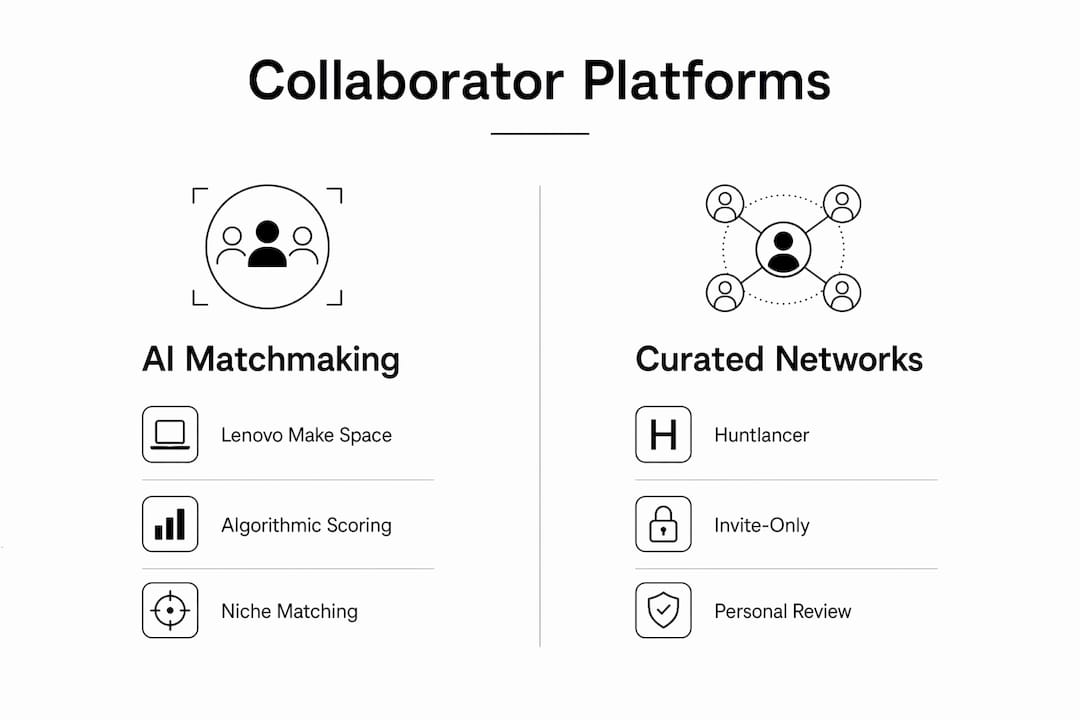
The search for creative partners used to mean cold emails, conference hallways, and word of mouth. Structured digital platforms have changed the math. Lenovo’s Make Space Network uses AI to match creators through digital third spaces, improving both discovery speed and partnership fit by processing questionnaire data across niche, audience size, and creative intent. The result is a shortlist of potential collaborators who already share your creative direction before you send a single message.
Invite-only networks like Huntlancer take a different approach by curating membership through personal review and promising matched introductions within 72 hours. The trade-off is exclusivity for speed and quality. You reach fewer people, but every introduction comes with a vetted portfolio and confirmed availability. For independent musicians, producers, and visual artists who have wasted hours chasing unresponsive leads, that 72-hour window is a meaningful upgrade.
Algorithmic scoring adds another layer of precision. Matching by niche, audience size, and collaboration intent can accelerate partnership growth by 2 to 3x when the weighting is calibrated correctly. This means a mid-size YouTube creator who scores partners on audience overlap and content cadence will close more productive deals than one who relies on gut feel alone.
Platform type | Best for | Key advantage |
AI matchmaking (Lenovo Make Space) | Creators wanting fast, algorithm-driven introductions | Processes niche, audience, and intent data simultaneously |
Invite-only networks (Huntlancer) | Professionals who prioritize vetted, quality matches | Curated profiles with 72-hour introduction guarantee |
Participatory co-creation platforms | Teams building long-term creative communities | 67.8% 30-day retention and measurable diversity gains |
General social platforms | Warm outreach to existing followers or mutual connections | Low barrier to entry, high volume of potential contacts |
Pro Tip: When evaluating any AI matchmaking tool, check whether it preserves your attribution and creative agency. Co-design research with 27 freelancers found that the biggest risk of AI collaboration tools is replacing human agency rather than supporting it. Use these platforms to find people, not to outsource the relationship.
How personality and social needs shape your collaboration search
Not every creative professional wants the same kind of working relationship, and your outreach should reflect that. Research published in Frontiers in Psychology found that creatives with a high need for belonging prioritize emotional communication in collaboration, while others prioritize task novelty and functional output. Sending the same pitch template to both types produces predictably mixed results.
Creatives who value emotional connection respond better to outreach that acknowledges their creative journey, references shared experiences, and frames the collaboration as a relationship rather than a transaction. Creatives who are driven by novelty and output respond better to pitches that lead with the concept, the format, and the creative challenge involved. Reading someone’s content before you reach out gives you enough signal to know which register to use.
Trust-building before the ask also changes acceptance rates significantly. Authentic engagement and showcasing your work before making a partnership request increases familiarity and lowers perceived risk for the other party. Commenting meaningfully on someone’s work for two weeks before pitching is not manipulation. It is relationship infrastructure.
For emotionally driven collaborators: open with a personal reference to their work, frame the project around shared values, and suggest a casual conversation before any formal commitment.
For output-driven collaborators: lead with the concept and format, include a brief and a timeline in the first message, and make the ask specific and time-bound.
For collaborators you have never interacted with: spend time in their public spaces first, share relevant work of your own, and let the pitch follow naturally from an established presence.
What collaborating with star creatives actually does to your work
Working with a high-profile collaborator is one of the fastest ways to raise your visibility, but the tradeoff is real. A study from Springer Nature on star collaborations found that non-star workers improve their task performance after collaborating with star performers, but they also risk suppressing their independent creativity afterward. The effect is stronger for female non-star creatives, who gain more performance benefit but face a sharper tension with their own creative voice.
This finding changes how you should approach high-profile partnerships strategically. The goal is to extract learning and exposure without letting the star’s aesthetic or workflow become your default. Treat the collaboration as a masterclass with a deliverable attached, not as a template for your future work.
Here is a practical framework for getting the most from a star collaboration without losing your creative identity:
Define your learning objective before the project starts. What specific skill, audience segment, or production technique do you want to absorb from this partnership?
Keep one solo project running in parallel so your independent creative voice stays active during the collaboration period.
Document your own contributions clearly throughout the process. This protects attribution and reinforces your sense of ownership over the work.
After the project ends, create something entirely on your own terms before pursuing the next high-profile partnership. This resets your creative baseline.
Evaluate the collaboration on two metrics: what it did for your visibility and what it did for your craft. If only one of those improved, adjust your strategy for the next partnership.
How to set expectations before a creative collaboration begins
The most common reason creative collaborations fail is not incompatibility. It is ambiguity. Pre-negotiating ownership, rights, compensation, and credit in writing before work begins prevents the rework, resentment, and broken relationships that come from assuming everyone is on the same page.
A written pre-collaboration agreement does not need to be a legal contract. A shared Google Doc or Notion page that both parties have reviewed and confirmed is enough for most independent creative projects. The act of writing it forces both sides to surface assumptions before they become conflicts. Structured input funnels that include briefs, deliverables, and timelines reduce back-and-forth and improve decision readiness for both parties.
Pro Tip: Use a simple one-page collaboration brief that covers five items: who owns the final output, how credit appears publicly, what each party delivers and by when, how revenue or usage rights are split, and what happens if one party needs to exit the project. Reviewing this document together before work starts is the single highest-leverage thing you can do to protect a creative relationship.
Ownership: specify who holds the master rights, the publishing rights, and any derivative use rights.
Credit: agree on exactly how each collaborator is named across platforms, press releases, and metadata.
Deliverables: list each party’s specific contributions with deadlines attached.
Compensation: state whether the arrangement is revenue-sharing, flat fee, barter, or exposure-based, and put the number or percentage in writing.
Exit clause: define what happens to the work if one party withdraws before completion.
Key takeaways
Creative professionals who find the best collaborators combine specific-value fit outreach, AI-assisted discovery platforms, psychosocial awareness, and written pre-agreements to build partnerships that last.
Point | Details |
Lead with specific-value fit | Name the overlap, define the deliverable, and state the next step in every pitch. |
Use AI platforms strategically | Tools like Lenovo Make Space and Huntlancer cut search time but require you to protect your creative agency. |
Match your outreach to personality type | Emotionally driven collaborators need relationship framing; output-driven ones need a brief and a deadline. |
Approach star collaborations with a plan | Set a learning objective and keep solo work running to protect your independent creative voice. |
Write the agreement before work starts | Pre-negotiating ownership, credit, and deliverables in writing prevents the most common collaboration failures. |
Why the pitch comes before the platform
I have watched hundreds of independent creatives cycle through every new matchmaking tool and networking event without landing a single meaningful collaboration, and the problem is almost never the platform. It is the pitch. Most creatives reach out with enthusiasm and no specificity, which puts the entire burden of imagining the partnership on the other person. That is a lot to ask of someone who does not know you yet.
The research on AI co-creation preferences is genuinely surprising to me. The fact that 76% of respondents preferred human-AI co-creation over human-human collaboration tells me that creatives are hungry for novelty and reduced friction, not necessarily for deeper human connection in every project. That is useful information. It means AI-assisted discovery tools are not a threat to authentic collaboration. They are a filter that gets you to the right human conversation faster.
What I would caution against is outsourcing your creative judgment to any algorithm. The platforms find the candidates. You still have to decide who is worth your time, your creative energy, and your trust. The best collaborations I have seen come from people who did the relational work before the formal ask, who showed up in someone’s creative space consistently before making a pitch. No algorithm replicates that. Use the tools to reduce search costs, then invest the time you saved into building the relationship properly.
— Christopher
Find your next collaborator on Studiom8
Studiom8 is built specifically for independent creators who are tired of searching for collaborators on platforms designed for something else entirely. The Studiom8 platform connects musicians, producers, engineers, podcasters, visual artists, and influencers in a space where collaboration is the point, not a side feature. You can find studio space, connect with creative professionals whose skills complement yours, and manage projects without the noise of traditional social media competition. For creators who want structured access to vetted collaborators and production resources, Studiom8 subscriptions provide the tools to move from idea to finished project faster and with the right people beside you.
FAQ
What is specific-value fit in a collaboration pitch?
Specific-value fit means your outreach immediately answers why you are a match, what the deliverable is, and what the next step looks like. Proposals built on this framework get faster acceptance because they reduce the mental work required from the recipient.
Which platforms are best for finding creative collaborators?
AI matchmaking networks like Lenovo Make Space and curated invite-only platforms like Huntlancer are among the most effective for targeted discovery. Participatory co-creation platforms show 67.8% 30-day retention rates, indicating strong long-term collaboration potential.
How does collaborating with a star creative affect your work?
Research from Springer Nature shows that collaborating with star performers improves task performance but can suppress independent creativity afterward. Keeping a solo project running during any high-profile collaboration helps protect your creative voice.
What should a pre-collaboration agreement cover?
A pre-collaboration agreement should address ownership rights, public credit, specific deliverables with deadlines, compensation structure, and an exit clause. Writing these down before work begins prevents the majority of creative partnership conflicts.
How do I tailor my outreach to different types of collaborators?
Creatives with a high need for belonging respond better to emotionally framed pitches that reference shared values. Output-driven collaborators respond better to concept-first messages with a brief and a timeline attached. Reading someone’s existing content gives you enough signal to know which approach to use.
Recommended
Comments